

How many times have you caught yourself saying, “Didn’t I just get my roots done?”
Maybe you’ve been coloring your hair for years and never thought much about it. You went in, had your roots done, and went about your life. But as more gray started coming in, those six weeks between appointments began to feel a whole lot shorter.
You’re still happy being a brunette or a blonde. You’re just not sure you want to keep chasing your grey every six weeks.
That’s often when people start looking at grey blending. They see pictures of women whose grey seems to grow naturally into the rest of their hair. There’s no hard line at the roots. The whole thing looks softer and easier.
And maybe you like that part. But there’s something else you’re not so sure about.
You’re not sure you actually want to be grey.
What Are You Really Trying to Get Away From?
I think this is where it’s helpful to forget about grey blending for a minute. Think about what’s actually bothering you.
Are you tired of coloring your hair? Or are you tired of having to cover your grey?
Those aren’t necessarily the same thing.
I talk with women who are truly ready to stop coloring their hair. They’ve been doing root touch-ups for years and they’re done. They want to start moving toward their natural grey. Eventually, they don’t want to color their hair anymore.
But I also talk with women who still like having color in their hair. They aren’t trying to become naturally grey. They just want their natural grey to grow in and blend better with the rest of their hair.
Both women may start out asking me about grey blending, but they’re trying to accomplish two very different things.
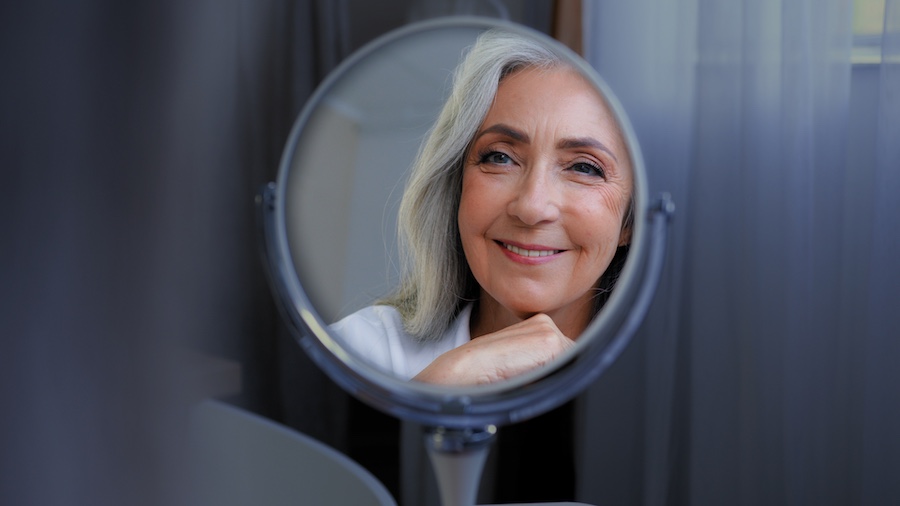
Then There’s the Question of What You Want to See in the Mirror
This is where the conversation gets even more interesting. It’s one thing to say you’re ready to stop covering your grey. It’s another thing to see yourself with grey hair.
If you’ve been a blonde or brunette your whole life, that’s a change. You may have pictures of grey blending that you love, but what exactly do you love about them?
Is it the grey? Is it the cooler color? Or is it simply that you can’t tell where the natural grey stops and the colored hair begins?
I’ve found that when we really get into this, a lot of women don’t actually want a grey toner on their hair. They don’t want to wake up the next morning, look in the mirror, and suddenly see themselves as grey.
What they like is how everything works together.
They want the blend.
That distinction matters because it changes where we’re trying to go.
Sometimes We End Up Somewhere We Never Intended to Go
I see this especially with brunettes. For a long time, when a brunette started getting more grey, we’d start adding highlights to help blend it. As more grey came in, we’d add more highlights, and over time she could end up much lighter than she ever intended to be.
Meanwhile, her natural salt-and-pepper grey is growing in at the roots while the colored ends can get warmer and brassier as the color and toner fade. She ends up with grey at the roots, lighter hair through the rest, and warmth on the ends.
And sometimes she doesn’t really like any of it.
She never wanted to be blonde in the first place. She was just trying to deal with her grey.
The funny thing is, sometimes when I’m working with someone in that situation, I don’t need to make her lighter. I need to put some of the darker color back in.
So Start With the Hair Color You Actually Want
If you’re thinking about grey blending, don’t start with techniques or the perfect inspiration photo. Take the grey out of the equation for a minute.
If you weren’t worried about covering your grey, what color would you actually want your hair to be?
Would you still want to be brunette? Would you still want to be blonde? Are you curious about what your natural grey would look like? Would you like to see some of your grey but still have other color around it?
I also think about whether someone looks better in warmer or cooler tones. Natural grey isn’t all the same either. It can be white, steely, salt-and-pepper, or somewhere in between. The colors around it can affect how the entire finished color looks against your skin.
You hear a lot now about people being winters, summers, springs, or autumns. However you describe it, I think the basic idea is useful. Hair color should work with the person wearing it.
I’ve seen plenty of people with hair color that just doesn’t work with their skin tone. So I don’t think the goal should be to make your hair “grey enough” to qualify as grey blending. The goal is to figure out what looks good on you while working with the grey you naturally have.

Think About Where You Want to Be a Year From Now
There’s one more question I think helps put all of this into perspective.
Where do you want this to lead?
Maybe you’re ready to start a transition toward your natural grey. You know it will be a journey with some maintenance along the way. But eventually, you’d like to stop coloring your hair altogether.
Or maybe you don’t want that at all. Maybe you still want hair color. You just want to get away from the six-week cycle of covering your roots.
You might be somewhere in between and not completely sure yet. That’s okay too.
You don’t need to know whether that means a toner, highlights, lowlights, demi-permanent color, or something else. We can figure that part out later. What helps is knowing what you’re trying to accomplish.
Are you trying to stop coloring your hair? Are you trying to stop covering every grey hair? Do you want to see your natural grey? Or do you mostly want the line between your grey and colored hair to stop being so obvious?
Once you separate those questions, it gets easier to see what you actually want.
And that brings us back to the question we started with.
Do you have to go grey to get grey blending?
Not necessarily.
Sometimes grey blending is a way to transition toward your natural grey. But sometimes you’re not trying to go grey at all.
You still want to see the hair color you love. You just want your grey to become part of it instead of something you’re constantly trying to cover.
You Don’t Need to Know If You’re Ready to Go Grey
You don’t need to have everything figured out before we talk. That’s what my Grey Blending Discovery Consultation is for.
We’ll look at your current color and natural grey and talk about what you want and how much maintenance you’re comfortable with. From there, we can work through what’s realistic for your hair.
You’ll leave with a personalized plan so you can decide what feels right for you.
If you’re ready to explore your options, schedule your Grey Blending Discovery Consultation here and let’s chat.